
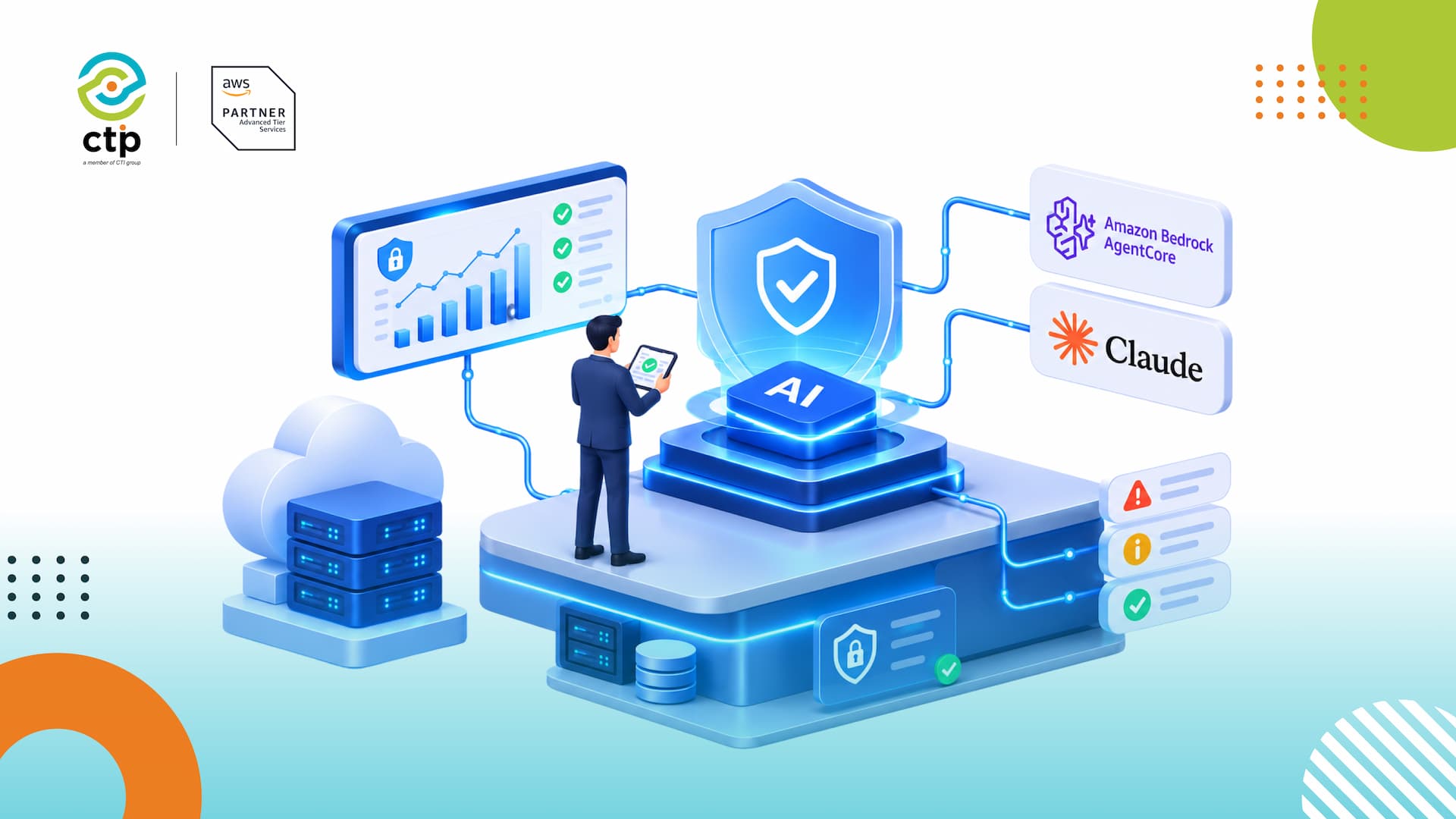
As enterprises move beyond AI experimentation toward autonomous AI agents, security and governance are becoming critical requirements for production deployment. Unlike traditional AI assistants that primarily generate responses, agentic AI systems can interact with enterprise applications, access business data, invoke backend tools, and execute multi-step workflows. This creates new risks, including unauthorized transactions, sensitive data exposure, prompt injection, and privilege escalation.
According to AWS, the challenge of scaling agentic AI is not just model capability, but also the operational infrastructure needed to ensure security, reliability, and control.
Combining Amazon Bedrock AgentCore with Claude by Anthropic offers an approach to addressing these challenges. Claude provides the intelligence for reasoning and executing complex tasks, while AgentCore supplies managed infrastructure for agent deployment, identity management, tool integration, and observability.
Key Takeaways:
- Controlled AI Execution: Enforce policies, execution boundaries, and approval workflows to prevent unauthorized agent actions.
- Enterprise-Grade Data Protection: Integrate identity controls and access policies to protect sensitive business information.
- End-to-End AI Visibility: Monitor agent activities, tool invocations, and execution traces to improve security and accountability.
Enterprise AI Safety and Governance Tools: How Amazon Bedrock AgentCore and Claude Work Together
Deploying AI agents in enterprise environments requires more than powerful language models. Organizations need a governance framework that ensures autonomous agents operate within defined security, compliance, and operational boundaries.
Claude by Anthropic, available through Amazon Bedrock, provides advanced reasoning and agentic capabilities for complex business workflows. Meanwhile, Amazon Bedrock AgentCore provides managed services to build, deploy, and operate AI agents at scale.
The two technologies server complementary roles:
| Technology | Primary Role |
| Claude by Anthropic | AI intelligence, reasoning, and task execution |
| AgentCore Runtime | Secure agent execution and session isolation |
| AgentCore Identity | Authentication and identity management |
| AgentCore Gateway | Secure integration with enterprise tools and APIs |
| AgentCore Policy | Policy-based authorization and execution controls |
| AgentCore Observability | Monitoring, tracing, and operational visibility |
AgentCore services can be used together or independently, depending on enterprise architecture requirements. Its model-agnostic design also allows organization to work with different foundation models and agent frameworks.
Also Read: Amazon Connect Expands into Agentic AI: What BPOs Should Know
Mitigating Brand Risk: Keeping Autonomous AI Actions Under Control
Autonomous AI agents can interact with business systems and execute transactions through connected tools. Without appropriate restrictions, unintended actions can create financial, operational, or reputational risks. Enterprises need deterministic execution policies to ensure agents only perform authorized actions.
Deploy AI Agents with Confidence Through Controlled Execution
With controlled execution boundaries, organizations can deploy AI agents into business workflows with greater confidence to accelerate AI adoption while maintaining appropriate operational oversight. Policy enforcement helps prevent unauthorized transactions, restrict sensitive operations, and introduce human approval for high-impact activities.
Enforcing Deterministic Policies for Every AI Agent Action
Amazon Bedrock AgentCore Gateway and its Policy Engine provide mechanisms to enforce authorization policies before agents access connected tools. Key capabilities include:
- Execution Restrictions: define which tools and actions agents are permitted to execute.
- Schema Validation: validate request structures and parameters before processing.
- Policy-based authorization: enforce conditions based on identity, action, and resource.
- Human-in-the-loop: integrate approval workflows for sensitive transactions through application-level workflow design.

Data Sovereignty: Ensuring AI Agents Access Only Authorized Information
Enterprise AI agents frequently interact with multiple departments, databases, and internal applications. Without proper identity and access management, agents may retrieve information beyond their authorized scope.
Business Outcome: Protect Sensitive Business Data with Role-Based Access
Organizations can strengthen data confidentiality by ensuring AI agents only access information relevant to their assigned responsibilities. Identity-aware access controls help reduce unauthorized data exposure, enforce departmental boundaries, and support enterprise data governance.
Tech Outcome: Integrating Enterprise Identity for Secure AI Access
Amazon Bedrock AgentCore Identity supports authentication and credential management for agents interacting with enterprise resources. It supports integration with identity providers through standards such as OAuth 2.0 and JWT-based authentication. Organizations can connect their existing identity infrastructure, including providers such as Microsoft Entra ID, Okta, and Amazon Cognito, depending on the integration architecture.
Combination of IAM policies and application-level retrieval filtering, to help ensure agents access only the resources permitted to their authenticated identity. Key capabilities include:
- Identity-aware authorization
- Secure credential management
- OAuth token handling
- JWT-based identity validation
- Fine-grained access policies
Also Read: Data Modernization for Enterprise AI: Build Your Data Layer Before AI Agent
Proactive AI Threat Defense: Blocking Prompt Injection and Data Exposure
AI agents introduce additional attack surfaces because they process external inputs, retrieve information, and interact with connected systems. Threats such as prompt injection, jailbreak attempts, and sensitive information exposure can compromise agent behavior or reveal proprietary business data. Therefore, organizations need security controls that evaluate both incoming requests and outgoing responses.
Protect Customer Trust and Corporate Reputation
Active threat defense helps reduce the risk of malicious prompt manipulation, inappropriate AI responses, and sensitive data exposure. By implementing security checks throughout agent interactions, organizations can strengthen customer trust and protect their corporate reputation.
Applying Automated Guardrails to AI Inputs and Outputs
Amazon Bedrock Guardrails and AgentCore Gateway support additional security controls for agent interactions. Though policy-based guardrails, organizations can evaluate content for:
- Prompt Injection Detection: identify malicious prompt manipulation and jailbreak attempts.
- Sensitive Information Detection: identify sensitive information such as email addresses, credentials, and other supported personal or financial identifiers.
- Content Filtering: apply content restrictions based on defined categories.
- Request and Response Inspection: use gateway policies and interceptors to inspect or transform incoming and outgoing traffic.
AI Governance and Compliance: Gaining Full Visibility into Agent Activities
As AI agents become part of enterprise operations, organizations need to understand not only what an agent produces, but also how it reaches decisions and executes actions. Without sufficient visibility, investigating unexpected agent behavior, troubleshooting failures, and demonstrating compliance can become challenging.
Simplify Compliance Reviews with Transparent AI Operations
Comprehensive operational visibility helps IT, security, and compliance teams review agent activities and investigate potential policy violations. A structured audit trail also supports internal risk assessments, governance reviews, and regulatory audit preparation.
Track Every AI Agent Action with End-to-End Execution Tracing
Amazon Bedrock AgentCore Observability provides monitoring and tracing capabilities for agent execution. Through integration with Amazon CloudWatch and OpenTelemetry instrumentation, organizations can gain visibility into:
- Claude Model Interactions: monitor model invocation activities and responses.
- Tool Invocations: track connected tools, execution steps, and results.
- Agent Execution Flow: review the sequence of operations within an agent session.
- Error Monitoring: identify failures, exceptions, and operational issues.
- Performance Metrics: monitor execution duration and resource utilization.
AgentCore traces can capture request details, processing steps, tool invocations, and response generation. Additional instrumentation may be required to capture application-level and framework-specific activities to help enterprises establish more accountable AI operations and maintain better control over production deployments.
Build a More Secure Enterprise AI Environment with AWS Only at CTP
Building secure enterprise AI requires more than integrating a foundation model. Organizations need the right architecture, governance policies, identity controls, and operational monitoring to ensure AI agents can operate safely at scale.
Computrade Technology Philippines, part of the CTI Group, is AWS advanced partner, to help enterprises explore and implement AWS-based solutions aligned with their AI adoption and business requirements. Connect with CTP to explore how Amazon Bedrock AgentCore and Claude can help your organization build a more secure and governed agentic AI environment.
Author: Ervina Anggraini – CTI Group Content Writer


